How much damage does a rock do? (wrong question!)
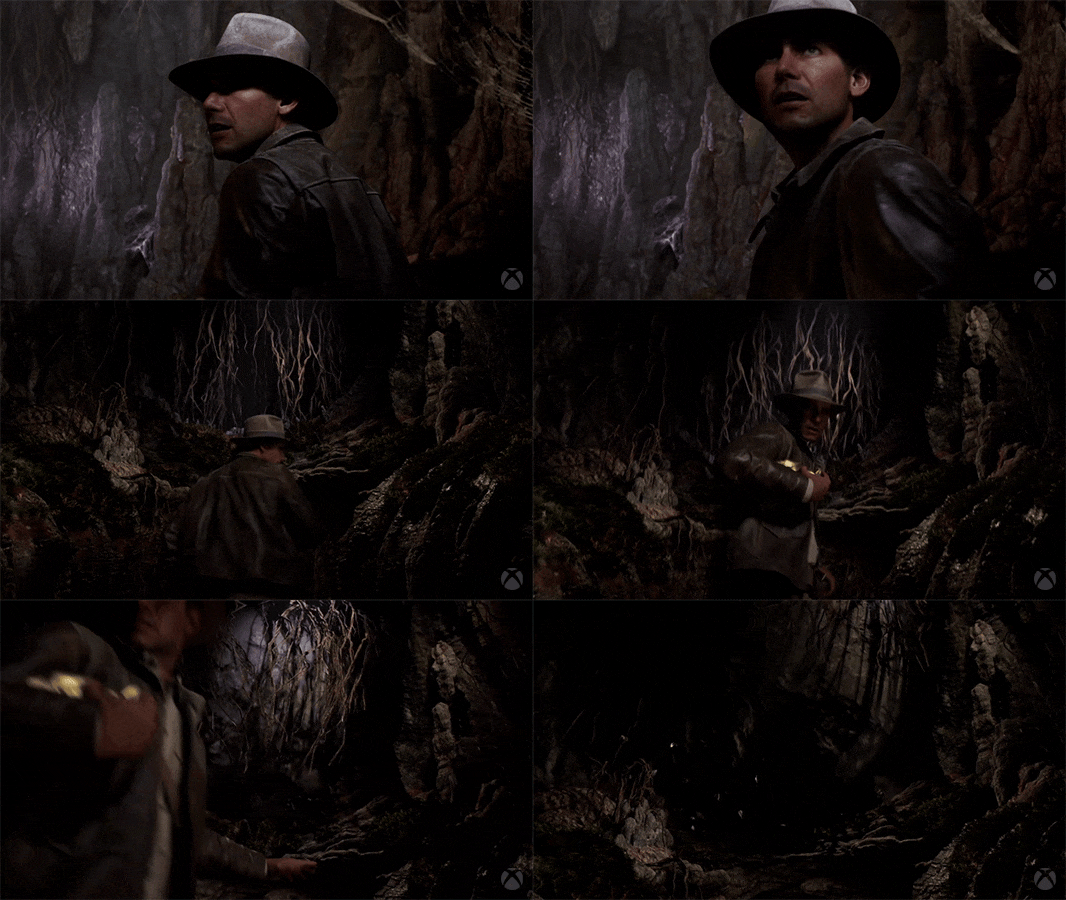
Alternative title: Rocks Fall; Who Dies?
I've kept names of people there out of this post, but if you were part of that conversation and want to be cited, let me know!
A conversation in the Sly Flourish Discord got me thinking about improvised damage in Daggerheart. The question goes something like: "If a player drops a rock on someone, how much damage should it do?"
The Daggerheart Core Rulebook ("CRB") doesn't give you a table for this. No "falling object damage by weight" chart. No improvised weapon entry that says "1d6, versatile." And I think that's on purpose, but it can leave GMs feeling unmoored when a player says "I want to shove this boulder off the cliff onto the bandit captain."
My answer: the rock doesn't have stats. The character does.
If you're coming from D&D 5E, you might think about objects as having intrinsic mechanical properties. Doors have HP, an improvised weapon deals 1d4 damage (or 1d6 if it resembles a weapon). Falling deals 1d6 per 10 feet. There's a number somewhere, and your job is to find it or extrapolate it.
OSR games often take a similar approach, though with more "rulings not rules" flexibility; but even then, the implicit frame is "what would this object do in the physics of the game world?"
Daggerheart, imho, doesn't work that way. [Ed. Note: neither does real life.]
Here's the reframe I want to offer:
Don't ask "how much damage does the rock do?" Ask "what ability is this character reflavoring?"
If the Warrior wants to drop a boulder on the bandit captain, look at their character sheet. Do they have a high-damage melee attack? A "strike with overwhelming force" type move? Cool: this is that move, narratively repositioned. The rock is set dressing. The damage comes from the character's existing capability, expressed through the fiction of "I shove this massive stone off a ledge."
If the Bard wants to do the same thing? Different answer. They probably don't have a "crush someone with a boulder" move. Maybe they're using their action to create an opportunity for the Warrior, or maybe they're doing something clever that keys off a different stat entirely. Maybe it's the Help action, where the rock distracts the bandit so the Warrior can more easily stab her.
The rock is the same rock. The characters are not. [Ed. Note: unless one of them is literally a rock person. Work with me here.]
This applies to adversaries too. If an NPC drops a rock on the party, look at their adversary stat block. What existing action or damage expression does this map to? The Bear's "Bite" action, reflavored as "hurls chunk of masonry with mouth"? The War Wizard's "Arcane Artillery," reskinned as "collapses the ceiling"? The stat block is your friend. Use it.
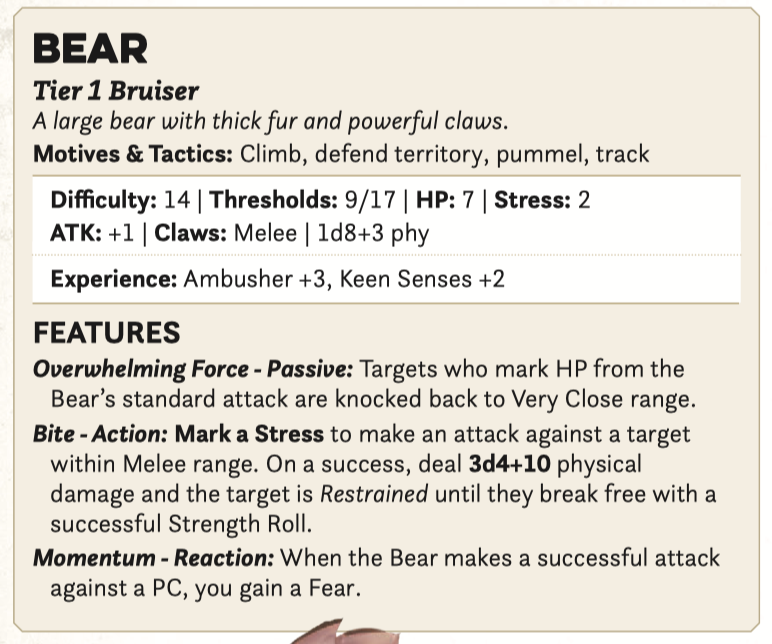
Tier 1 Bruiser
A large bear with thick fur and powerful claws.
Motives & Tactics: Climb, defend territory, pummel, track
Difficulty: 14 | Thresholds: 9/17 | HP: 7 | Stress: 2
ATK: +1 | Claws: Melee | 1d8+3 phy
Experience: Ambusher +3, Keen Senses +2
FEATURES
Overwhelming Force - Passive: Targets who mark HP from the Bear’s standard attack are knocked back to Very Close range.
Bite - Action: Mark a Stress to make an attack against a target within Melee range. On a success, deal 3d4+10 physical damage and the target is Restrained until they break free with a successful Strength Roll.
Momentum - Reaction: When the Bear makes a successful attack against a PC, you gain a Fear.
The Sequence
Here's how I'd handle it at the table:
- Player describes a creative action. ("I want to kick that brazier full of coals onto the goblin.")
- GM asks about intent and desired effect. Damage? A disabling condition? Creating an opportunity? This matters because it shapes what we're looking for.
- Ask if the PC has a power that captures that effect. "Do you have something that deals magic damage?" or "Do you have a move that staggers or disorients?" If yes: great, you're reflavoring that power. The brazier is the fiction; the ability is the engine.
- If not, there are improvised tables you can use as a fallback.
This sequence does a few things: it keeps the player's creativity front and center, it grounds the ruling in existing character capabilities, and it gives you a fallback that doesn't require you to invent physics on the fly.
I think this is freeing, not constraining. You don't have to invent physics. You don't have to balance improvised damage against the game's math. You just have to ask: what can this character already do, and how does the fiction express it this time?
To Sum Up
- Daggerheart doesn't give you improvised damage tables because objects don't have stats; characters do
- When a player wants to do something creative with the environment, start with their sheet for an ability to reflavor - to paint the scene (which is a kind of agency) [Ed. Note: yes, I'm citing myself. It's my blog.]
- If nothing fits, use a generic benchmark (like those on Page 15 here [PDF])
- Same principle applies to NPCs: map environmental actions to existing adversary stat block entries
- The question isn't "what does the rock do?"; it's "what is this character doing, with a rock?"
What do you think?
As an alternative to this, would you prefer a world with stats, independent of the characters? How does an improvised rock attack work on your favorite RPG?